Rental Fleets and Preseason Retail: Where Snowboard Covers and Ski Straps Fit the 2026-27 Stock-Up
The second half of October is when the snowsports trade stops talking about the coming season and starts servicing it. Retailers reset walls and book fitting appointments, rental desks assemble and label fleets, and the first European glacier areas have already been running for a fortnight. For accessory suppliers, this is the fortnight when a good season and a chaotic one separate, not by the hardgoods on the shop floor but by whether the covers, straps and protectors arrived in the right specification.
Rental Is No Longer the Entry Level of the Business
Ski Area Management’s 2026-27 rental gear review, published in its January 2026 issue under Rick Kahl’s byline, opened with an observation that reframes how accessory buyers think about volume. Citing Snowsports Industries America figures, it described the United States gear market as splitting roughly into 30 percent rental, 20 percent lease or demo, 30 percent specialty retail and 20 percent online. Rental and demo are no longer a side channel; the review also noted a clear consumer drift toward leasing and demo rental and away from outright purchase.
The same review captured the operational consequence through the people who sell into it. Fischer’s vice president of sales, Scott Ford, described how demo has expanded beyond its old limits and is now effectively another tier of rental. Salomon’s winter sports equipment vice president, Erik Anderson, explained the other side of the table: rental partners appreciate two- to three-year carryover cycles because it keeps fleet management from becoming chaotic. More equipment, in circulation for longer, passing through more hands.
What Fleet Buyers Actually Standardise
Vail Resorts’ announcement of 16 March 2026 illustrates where rental operations are heading. The company set out plans to fold the best features of its My Epic Gear programme into traditional gear rentals, so that guests renting demo skis or snowboards could select their model online across 12 resorts, and to extend premium technologies such as BOA boot closures into the rental pool.
The direction is clear: rental equipment is presented with retail-grade expectations, while the equipment itself still has to survive an unusually hard life. Every item is handled by staff who did not buy it and guests who did not pack it, moved by van and cargo box, and stored in whatever space the shop can spare between Saturday and Wednesday.
The Retail Side Books Differently
Retail buyers work to a different rhythm. The pre-season conversation in a specialty shop is about the customer’s existing setup as much as the new one: bases, edges, bindings, boots and helmets all get inspected before the first day on snow, which is exactly the checklist Christie Sports laid out in its 2026-27 winter gear guide published on 15 October 2026. That service conversation creates an accessory sale almost automatically, because a customer who has just paid to have edges tuned is receptive to keeping them intact on the drive home.
Where Covers and Straps Enter the Checklist
This is the practical overlap between the two channels. A rental fleet needs protection that is uniform, replaceable and cheap enough to treat as a consumable. A retail floor needs protection that looks like part of the product, with a visible window so a customer can see the board and a carry handle that survives a season. Both need the same underlying construction: a neoprene shell that stays supple below freezing, a lining that will not abrade a base, and hook-and-loop closures sized for gloved hands.
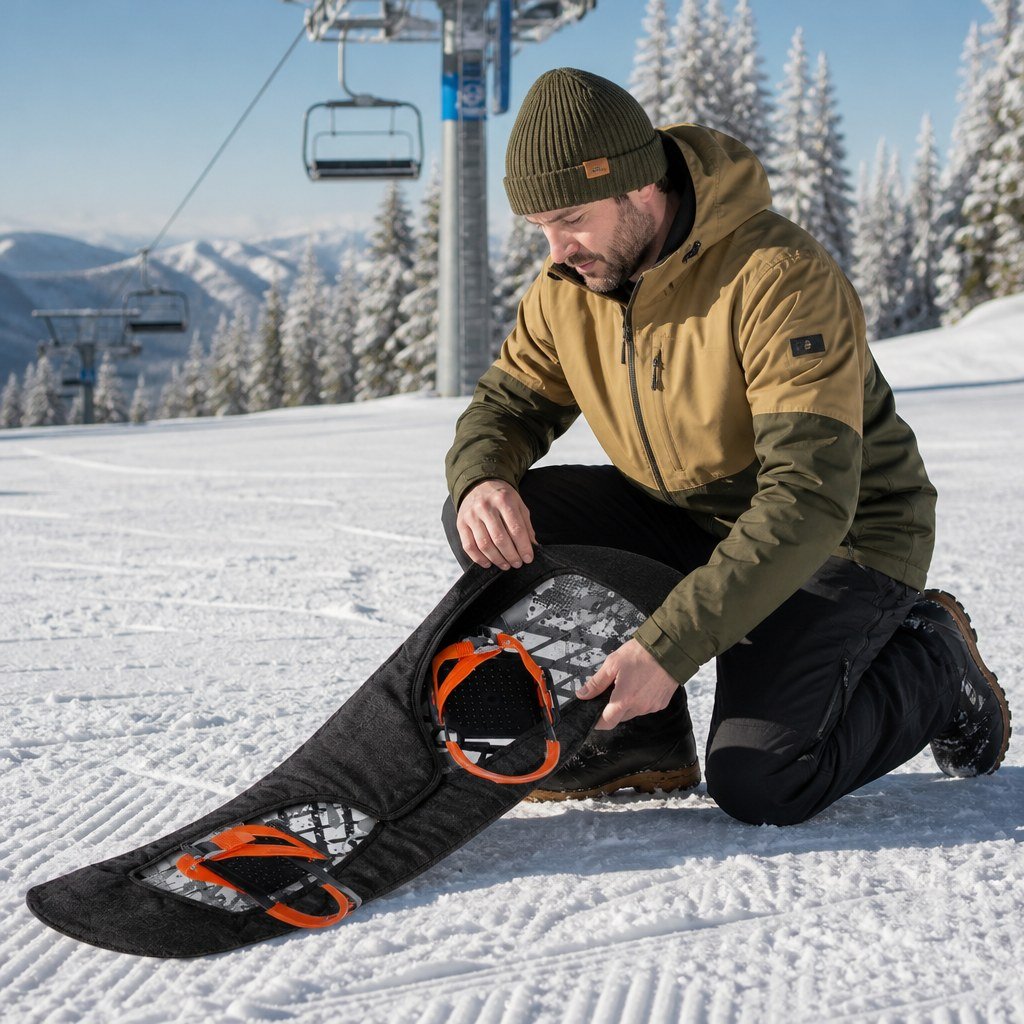
Treat Accessories as a Fleet Consumable
Fleet managers who plan accessories properly converge on a handful of habits. They standardise on one or two lengths rather than a full size ladder, so a replacement can be pulled from the same bin in February as in November. They specify the closure hardware explicitly, because a hook-and-loop tab that fails in the cold is a warranty conversation, not a spare part. And they ask for print that survives washing, salt and UV rather than flaking off by mid-season.
Retail buyers add a fourth habit: they consolidate. A shop already sourcing equipment straps for bike and outdoor categories, and high hiking accessories for the shoulder seasons, gains little from a different supplier for snowboard covers. One specification language across categories means one sampling round, one compliance file and one reorder conversation. Our elite snowsports line is organised that way, and the adjustable ski straps with hook-and-loop fasteners are built as a single SKU spanning junior rental skis through wide all-mountain pairs.
Build the Spec Now, Not in December
Every year the same pattern repeats: the covers that were a line item in September become urgent in December, and by then the only decision left is which specification is close enough. Starting the conversation while fleets are still being assembled keeps that choice in the buyer’s hands, and keeps changes such as a longer body, a scan window or a co-branded print inside the sample stage.
We are a factory-direct OEM/ODM manufacturer of neoprene and webbing straps, covers and protectors, with low MOQ programmes for trial orders and repeat runs, REACH and RoHS material compliance, and we can arrange BSCI audit / ISO 9001 recertification on request. Send your specification or a reference sample and we will reply with a quotation within 24 hours: hxwdavidli@gmail.com or WhatsApp.