Trail Running’s Long Season: Hydration Vest Specs Buyers Compare
Trail running reached 17.2 million participants in the United States in 2025, up 6.6 percent year over year and 57 percent since 2019, according to the Outdoor Industry Association’s 2026 Running Report. Core trail runners grew 7.8 percent, which is the opposite of what is happening on the road. Retail has already responded: REI describes trail as its fastest-growing footwear category, and Brooks reported trail styles up 71 percent year over year in the second quarter of 2026.
Attachment rate is the number that matters
A divisional merchandise manager at REI told Retail Brew in September that hydration vests carry some of the highest attachment rates to trail-running footwear, meaning they are bought at the same time as the shoe, and that vest sales grew in the same range as shoes over the previous year. Trail sales at the retailer were up roughly 12 to 19 percent year to date depending on gender and category, against flat road-running growth.
For a supplier, attachment rate changes the conversation. A vest is not a standalone accessory sold on its own merits; it is part of a kit decision made in the ten minutes a customer spends at a fitting bench. That makes fit, not features, the deciding factor.
The specifications buyers compare
Four things get tested in a sample review. First, bounce: a vest loaded with two 500 ml soft flasks and a shell should stay quiet at tempo pace, which is a function of sternum strap geometry and how the front panels are cut, not of fabric weight. Second, sizing ladder: a 5, 8 and 12 litre family covers most of the market, and a women’s-specific torso length is now a requirement rather than an option. Third, pocket layout: a front stretch pocket that swallows a phone, a soft flask pocket that can be reached without unclipping, and a rear compartment that takes a folded shell.
Fourth, hardware and finishing: reflective trim on the front and back, a pole attachment that does not require a separate quiver, and edge binding that does not abrade a base layer over 20 km.
Sourcing takeaway
Quote the vest as a three-size family with one shared pattern and two torso lengths, and send a bounce-test video with the sample rather than a fabric specification sheet. Retail buyers evaluate this category at the fitting bench, and the supplier who supplies a sizing card and a wash-care label that survives 30 cycles removes the main objection. Keep the first order narrow, three sizes and two colourways, and use the reorder window in late winter, when trail race registration opens, to add the larger volume.
Developing a hydration vest programme? See the trail running range.
Sources
Outdoor Industry Association, “2026 Running Report”, https://outdoorindustry.org/2026-running-report/
Retail Brew, “Trail running hits its stride”, 8 Sep 2026, https://www.retailbrew.com/stories/trail-running-hits-its-stride
Glacier Openings Signal the 2026-27 Start: A Q4 Buying Guide for Ski Straps and Snowboard Covers
Mid-October is the point in the calendar when the ski season stops being a forecast and starts being a schedule. European glacier resorts have already spun their first lifts for 2026-27, snow-farming operations in Lapland have uncovered last winter’s stockpile, and rental managers on both sides of the Atlantic are working through the final weeks of fleet assembly. For buyers of ski straps, snowboard covers and neoprene tip protection, that schedule doubles as a procurement deadline, because the accessories that protect equipment in transit are ordered in exactly the same window as the equipment itself.
Europe’s October Openings Have Already Set the Tone
SnowBrains published its seasonal round-up of European October openings on 26 September 2026. Sölden and Hintertux in Austria’s Tyrol were both listed for 2 October, alongside Levi and Ruka in Finland, the two non-glacial resorts that depend on snow farming, storing the previous season’s snow under insulating covers through the summer months. Saas-Fee in Switzerland followed on 3 October, Stubai Glacier on 9 October, and both Kitzsteinhorn and Titlis on 10 October. Further out, Diavolezza in the Engadin, Kåbdalis in Swedish Lapland, Mölltal and Schilthorn were expected to join later in the month.
That same reporting carried a caution worth repeating to anyone building stock plans around opening dates: October openings are provisional. Glacier and snow-farm conditions can move a date by days or even weeks, and terrain is limited in the first weeks, with a handful of glacier lifts and groomed upper slopes rather than a full resort footprint. InTheSnow’s 1 October 2026 guide to where to ski in October made the same point: the European glacier list simply grows through the month.
Why a Short Opening List Still Moves Accessory Orders
The commercial signal here is not the number of resorts that are open. It is the sequence those openings trigger. Once lifts turn, a chain reaction starts: demo skis leave the tuning room, rental boards get racked and labelled, retail floors reset their wall displays, and the transport and storage cycle begins in earnest. That cycle is where straps and covers earn their place in the purchase order. A pair of skis carried on a roof rack, stacked in a rental van, or stood upright in a shop for eight weeks is a pair of skis collecting edge nicks, base scuffs and binding damage. Neoprene tip and tail protectors and hook-and-loop retaining straps are inexpensive insurance against precisely that wear.

The Q4 Buying Window, in Practical Terms
Q4 accessory purchasing usually splits into two very different conversations. The resort and rental channel values consistency: the same strap length, the same closure, the same shell weight season after season, so that a missing part can be replaced from a single SKU and a fleet technician does not have to relearn the product. The retail and online channel values differentiation: printed covers, branded pull tabs, retail-ready packaging and colourways that match the hardgoods sitting on the same shelf.
Both channels, however, tend to ask the same three questions before they commit. Does it fit the widest range of shapes we carry? Will the closure survive a full season of glove-on handling? And can the supplier hold the specification across repeat orders rather than quietly changing the laminate between shipments?
Specifying for Snow, Salt and Storage
Neoprene is the default shell material for a reason. It stays flexible well below freezing, it resists the abrasion that thin nylon-only sleeves suffer against metal edges, and it can be laminated to a softer lining that will not dull a base in storage. Hook-and-loop closures need to be sized for gloved hands and wide enough to hold a ski pair or a board without over-cinching, and the stitching at the stress points matters more than the shell weight on the spec sheet. Beyond construction, European and North American buyers increasingly ask for REACH and RoHS material compliance documentation as part of the standard technical file, and for material declarations to travel with the shipment rather than arrive after it.
Our own range follows the same logic. The elite snowsports collection is built around a small number of shell weights and a wide fit range, and the adjustable ski straps with hook-and-loop fasteners are designed to be ordered as one SKU covering everything from a junior rental ski to a wide all-mountain pair. Buyers who also stock equipment straps for bike and outdoor ranges can consolidate webbing and closure specifications across categories.
Talk to the Factory Before the First Big Dump
Sourcing accessories late is rarely a cost problem. It is a fit problem: the covers arrive after the fleet is already racked, and the only remaining decision is whether to use them at all. Working factory-direct with an OEM/ODM partner earlier in the window keeps specification changes, whether that means a longer body, a clear window for rental barcode scanning or a printed logo, inside the sample round instead of the shipping round.
We manufacture neoprene and webbing straps, covers and protectors as a factory-direct OEM/ODM supplier, with low MOQ programmes for first orders and repeat runs, REACH and RoHS material compliance, and we can arrange BSCI audit / ISO 9001 recertification on request. Send a specification sheet or a reference sample and we will come back with a quotation within 24 hours: hxwdavidli@gmail.com or WhatsApp.
Ski Strap OEM Buying Guide: Specs, Customization & Sourcing for 2026/27
The 2026/27 pre-season sourcing window is open. Ski straps look like a small item, but they are a genuine safety component, a brand touchpoint on every pair of skis, and one of the fastest accessories to move at retail. This OEM buying guide walks through the specifications, customization options and factory checks to lock down before you order.
What a Ski Strap Really Does
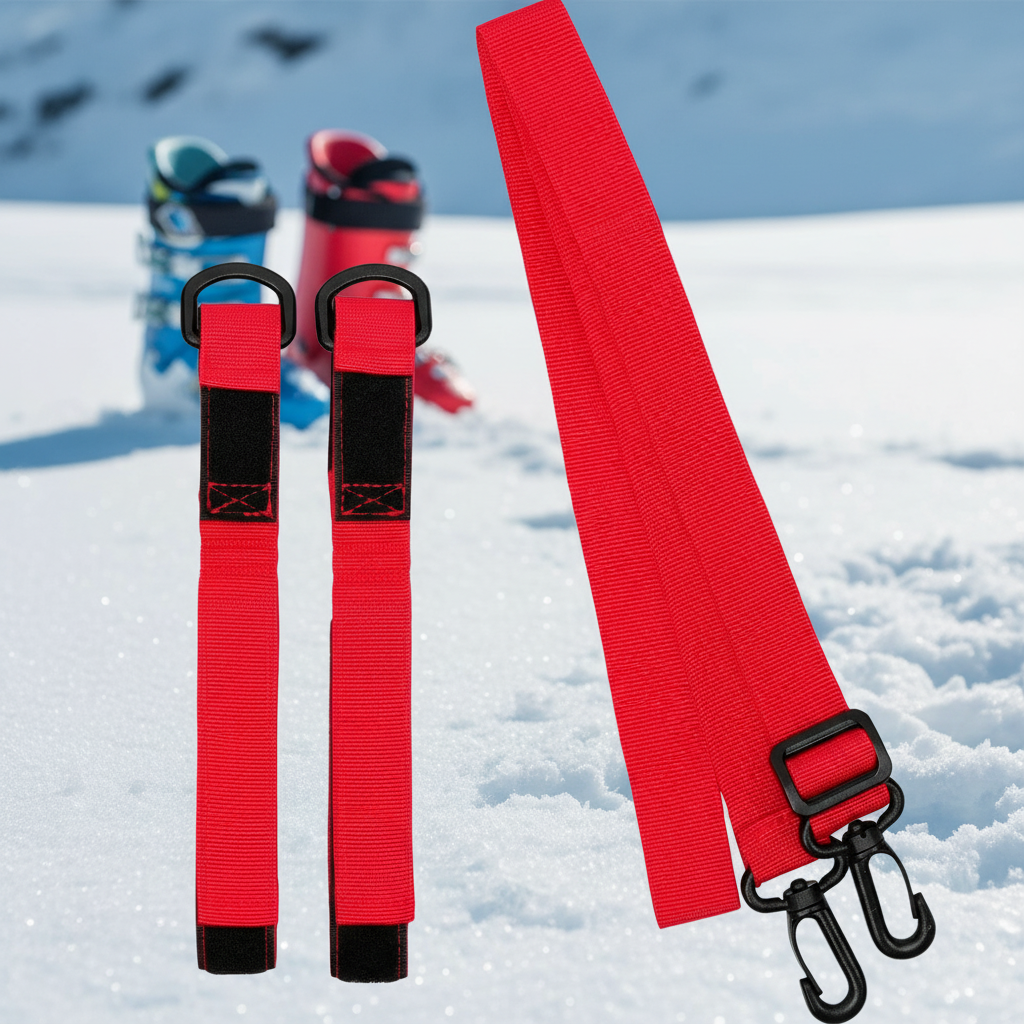
A well-made ski strap keeps skis together and protected in transit and storage, holds poles alongside the pair, and — printed with your brand — turns every trip to the mountain into an advertisement. For retailers and brands, it is also an easy add-on sale with year-round reorder potential.
Core Specifications to Decide First
- Width and length: straps should match the ski profile they carry — wider woven straps suit adult all-mountain skis, while slimmer versions work for children’s and touring setups. Confirm your target lengths before sampling.
- Hook & loop configuration: decide the hook-to-loop ratio, the attachment method (sewn end loops, velour protectors or soft EVA pads where the strap wraps the ski edge) and whether the strap is adjustable or fixed-length.
- Webbing and materials: choose between polyester webbing and elastic options, specify edge protection for the ski finish, and make sure all materials meet EU REACH and RoHS requirements from the start.
- Hardware and finishing: metal or plastic buckles, anti-slip coatings, stitched reinforcement at stress points, and clean edge finishing all affect both durability and the price.
Branding and Retail Presentation
- Printing: heat-transfer, screen printing or woven labels — each gives a different look and durability on the strap surface. Supply your logo artwork in vector format for the cleanest result.
- Colorways: match strap and pad colors to your seasonal line; custom colors are normally available from the sampling stage.
- Retail packaging: header cards, hang tags or poly-bag bundles with your SKU barcode make the product retail-ready and protect it in transit.
What to Confirm with Your Factory
- Sampling: request physical samples (not only photos) and test them against your own skis before approving bulk.
- MOQ and lead time: clarify minimum order quantities and production lead time for your season — pre-season orders protect capacity before peak demand.
- Compliance: ask for REACH/RoHS declarations and test reports, and confirm factory audits such as BSCI and ISO 9001.
- Quality control: agree on stitch density, print adhesion and strength checks, plus inline and final inspection before shipment.
One Factory, From Design to Delivery
Vertasport has manufactured hook & loop ski straps and snowsports accessories for leading brands across Europe and North America for two decades — with low MOQs for market testing, REACH/RoHS-compliant materials, and BSCI/ISO 9001 certified production. Start with our ready-made adjustable ski strap or explore the full Elite Snowsports range, then customize to your brand.
Ready to spec your 2026/27 program? Email us or message on WhatsApp — we reply within 24 hours.