Marathon Major Week: What Road-Race Demand Does to Accessory Orders
The TCS New York City Marathon takes place on 1 November 2026, the anchor of the autumn major season. New York Road Runners reports 59,226 finishers in 2025, an average finish time of 4:32:25 and entrants from 130 countries. That profile, large, slow and international, is a better description of road-race demand than the elite field is, and it should shape what an accessory programme orders for the following season.
Road running is growing at the casual end
The Outdoor Industry Association’s 2026 Running Report puts road running at 52.3 million participants in 2025, second only to hiking among outdoor activities. The composition matters more than the total. Over three years, casual road running grew about 7 percent annually while the core segment, runners who get out 50 or more times a year, slipped roughly 1.1 percent. In 2025, some 29 million road runners did not run often enough to count as core.
An average finish time of 4:32:25 at the largest marathon in the field tells the same story. Most of the people on the start line are not chasing a personal best. They are completing an event they trained for in blocks, and they buy gear around that event rather than through the year.
Two demand curves, two order profiles
Race week concentrates purchases into an expo and a single weekend: kit bags, shoe bags, number belts, lightweight rain shells, and anything that can carry a phone and a layer for four hours. Those items reward low unit cost, fast print turnaround and simple sizing, because the buyer is buying a souvenir as much as a tool.
The second curve is slower and more valuable. A first-time marathoner who finishes in 4:30 often signs up for a half the following spring, and buys a hydration vest, a better belt and a shoe bag in the months after the race. That repeat demand is where specification and margin sit, and it arrives in January and February, not in race week.
Sourcing takeaway
Split the assortment rather than averaging it. Run event-driven items as a printable, low-SKU line with a 10 to 12 week cut-off before race week, and hold the technical line for the January reorder, when race finishers convert into regular runners. Ask for a two-colour print option on the event line so a distributor can serve several races from one stock position, and keep the technical belt and vest programme free of event-specific artwork so it survives the season. Suppliers who can prove both lead times in one quote take the whole account.
Planning a road-race accessory programme? See the running range.
Sources
New York Road Runners, “TCS New York City Marathon”, https://www.nyrr.org/tcsnycmarathon
Outdoor Industry Association, “2026 Running Report”, https://outdoorindustry.org/2026-running-report/
Snowmaking Upgrades and the Real Start of Winter Inventory
Snowmaking capital is the most reliable early-season signal a buyer gets. New Hampshire’s ski areas published their 2026-27 investments on 13 October, and Alterra Mountain Company committed more than $350 million across its destinations for winter 26/27 on 9 September, naming new fixed and mobile snow guns among the improvements. Neither announcement mentions accessories, and both change when accessories are needed.
Water and power, not gun count, set the opening date
Pats Peak is the clearest example. The centrepiece of its programme is a new 21-million-gallon snowmaking reservoir, plus 3,000 gallons per minute of additional pumping capacity that takes the total to nearly 8,000 gallons per minute. Summit electrical capacity triples, and the number of guns that can run at the same time rises from 100 to more than 200. The stated result is roughly a 50 percent cut in the time needed to bring the mountain to full operation.
Gunstock is spending $4.5 million inside a two-year, $9 million plan, with about $1.4 million of that on snowmaking: 5,000 feet of new pipe and a separation of the upper and lower systems so both can make snow simultaneously. Attitash is adding low-energy guns on the Saco Trail, and Wildcat is installing a new air transducer to make its air system respond faster. Vail Resorts notes more than $100 million invested in snowmaking across its portfolio since 2015.
Why full operation is an inventory date
When a mountain reaches full operation faster, terrain opens earlier in the holiday run-up rather than during it, and the rental fleet goes out sooner. The accessories bolted to that fleet move on the same clock: strap sets, padded bags, board covers, boot and goggle covers. A resort that opens a week earlier does not place a larger order; it places the same order a week earlier, which is precisely what a factory calendar struggles to absorb in November.
Sourcing takeaway
Ask which accounts have funded snowmaking this season, then treat them as early-season accounts with a separate shipping window rather than a share of a single November container. On the product side, the spec that survives an early opening is boring and specific: a strap that stays adjustable at minus 10 Celsius, a bag handle that does not delaminate when wet, and a buckle that a gloved hand can open in one motion. Suppliers who can ship a 200-piece mixed carton in ten days win the top-up business that the big container cannot serve.
Building a winter programme with a forward shipping calendar? Review the snowsports range.
Sources
Ski New Hampshire, “New Hampshire Ski Areas Invest in Snowmaking, Lifts, Terrain and More Ahead of 2026-2027 Season”, 13 Oct 2026, https://www.skinh.com/news/new-hampshire-ski-areas-invest-in-snowmaking-lifts-terrain-and-more-ahead-of-2026-2027-season
Alterra Mountain Company, “Alterra Mountain Company Invests Over $350 Million in Capital for 26/27”, 9 Sep 2026, https://www.alterramtn.co/en/news/alterra-mountain-company-invests-350-million-in-capital-for-2627-across-its-family-of-destinations
Vail Resorts, “Is Winter About to Show Off? Vail Resorts Announces 2026/27 Opening Dates”, 18 Aug 2026, https://news.vailresorts.com/2026-08-18-Is-Winter-About-to-Show-Off-Vail-Resorts-Announces-2026-27-Opening-Dates-as-Super-El-Nino-Builds-Anticipation-for-Great-Powder
2026/27 Ski Season Opening Calendar: What It Means for Accessory Stocking
The 2026/27 northern-hemisphere season now has a published shape, and it is tighter than last year’s. Vail Resorts released its opening lineup on 18 August, Tahoe resorts confirmed targets in mid-October, and Utah’s resorts have posted dates into December. For accessory buyers, those dates are not travel planning. They are the last dates on which a replenishment order can still reach a rental counter or a retail wall before the first busy weekend.
California first, then a crowded three-week window
Mt. Rose Ski Tahoe is targeting Friday 6 November after firing its snowmaking system on 12 October, the earliest start in Tahoe for four straight seasons. Mammoth Mountain is set for 13 November. Heavenly and Northstar both target 20 November, Palisades Tahoe 25 November, Sugar Bowl 27 November, Diamond Peak 3 December and Kirkwood 4 December. In Utah, Brian Head opens 6 November; Park City Mountain, Alta and Solitude open 20 November; Snowbird and Snowbasin 27 November; Deer Valley 5 December; Powder Mountain 11 December. Vail’s own list runs Keystone as soon as possible in October, Breckenridge 6 November, Vail Mountain 13 November, then Whistler Blackcomb, Park City, Heavenly and Northstar together on 20 November, with Beaver Creek and Crested Butte on 25 November.
The operational detail matters more than the date itself. Mt. Rose opens only once a signature intermediate trail carries a 10 to 14 inch base over at least 1,000 feet of vertical, which is why its target can move a week without notice. Every date listed is conditions permitting.
What a compressed calendar does to reorder math
Between 6 and 27 November, most of the western North American market switches on at once. Accessory consumption does not ramp gently across that window; it steps. Rental counters need straps, padded ski bags and board covers on day one, because a fleet without them cannot be handed out cleanly. Retail needs the same items one to two weeks later, when early pass traffic turns into storage and travel purchases.
Sourcing takeaway
Treat 6 November as the effective cut-off for full-container programmes, and hold a small buffer of mixed cartons for post-opening top-ups. Two specifications decide whether a fast reorder is even possible: a strap length range that covers 150 to 190 cm skis without a second SKU, and carton labelling that lets a rental manager split a mixed box by length at the loading dock. Buyers who lock colours, logo placement and carton artwork in October avoid the tooling queue that forms in December, and they keep the option of air-freighting a single size rather than a full assortment.
Reviewing a winter accessory programme? See the snowsports line.
Sources
Vail Resorts, “Is Winter About to Show Off? Vail Resorts Announces 2026/27 Opening Dates as Super El Nino Builds Anticipation for Great Powder”, 18 Aug 2026, https://news.vailresorts.com/2026-08-18-Is-Winter-About-to-Show-Off-Vail-Resorts-Announces-2026-27-Opening-Dates-as-Super-El-Nino-Builds-Anticipation-for-Great-Powder
Sierra Rec Magazine, “Lake Tahoe Ski Season 2026-27 Opening Dates”, 15 Oct 2026, https://sierrarecmagazine.com/lake-tahoe-ski-resort-opening-dates-2026-27/
Ski Utah, “2026-27 Utah Ski Resort Opening Dates”, https://www.skiutah.com/blog/authors/yeti/utah-ski-resort-opening-dates/
After the Sölden Opener: How the 2026/27 Race Calendar Sets the Accessory Order Rhythm
Sölden, Austria — 26 October 2026. The Rettenbach giant slaloms that opened the 2026/27 Audi FIS Ski World Cup are now behind the calendar rather than ahead of it. For the trade, the useful reading of the weekend is structural rather than competitive: the season’s first two race days have moved the mountain market from preparation into consumption, and every date that follows now functions as a deadline for somebody’s order book.
The dates that now define the autumn
Sölden’s opener was fixed long before the first snow gun ran: giant slalom on the Rettenbach Glacier on Saturday 24 October and Sunday 25 October, with the race hill passing its official snow control on 16 October, as reported by Unofficial Networks. That detail matters to suppliers more than it looks. Snow control is the point at which a resort commits publicly that the terrain and the infrastructure will hold, and it is usually the last confirmation a rental buyer gets before signing off a season’s accessory quantities.
The tour then stays in the Ötztal valley for its next Austrian stop. Gurgl hosts World Cup slalom on 21 and 22 November 2026, and the resort’s own event pages describe the Kirchenkar slope in Hochgurgl in unusually precise terms: a 210-metre vertical drop, starting at 2,475 metres and finishing at 2,265 metres. A slalom hill with that profile is steep, short and hard on equipment — which is exactly the profile of hill where rental fleets and ski-school inventories get hammered first.
Amsterdam, then the valleys
Between those two race weekends sits the trade’s own fixture. ISPO runs at RAI Amsterdam from 3 to 5 November 2026, the first edition in Amsterdam after 25 years in Munich, according to RAI Amsterdam’s own announcement. In practice the fair splits the European autumn in half: assortments that are not settled in Amsterdam tend to be settled in a hurry afterwards, at the point when resorts start publishing their opening dates.
Those dates are already public. Ischgl is scheduled to begin its 2026/27 season on 26 November 2026, and Kitzbühel is described as opening in phases from 6 November, reaching full-area operation later in the season, per Alpy’s Austria opening-dates roundup published on 29 September 2026. Austria’s national tourism board summarises the same pattern more broadly: most Austrian resorts open between late November and mid-December, snow and temperatures permitting.
Read together, the calendar describes a demand curve that is much shorter than the season itself. A resort may operate for five months; the window in which its straps, covers and carry systems are bought is a fraction of that, and it closes before the lifts turn.
Where hardware fails in the cold
Accessories are a low-ticket, high-consequence category. Nothing in a rental shop ends a day faster than a strap that will not hold a ski pair together at minus fifteen, or a cover whose base has been cut through by an edge after a single bus transfer. The failure modes are consistent and boringly predictable: hook-and-loop that packs with ice and stops engaging, webbing that stiffens until it will not thread through a buckle with a gloved hand, neoprene that compresses and stays compressed, stitching that creeps where the load path turns a corner.
Designing for those conditions is a materials question before it is a design question. Loop density, the tenacity of the hook, the weave and coating of the webbing, the shore hardness of a plastic buckle that has to survive being stepped on in a boot room — each of those choices shows up as a return rate rather than a specification sheet. Buyers who test in a freezer rather than a showroom tend to specify differently, and the specification usually gets simpler, not more complex.
Built for the window, not the catalogue
Vertasport is a factory-direct OEM/ODM manufacturer of sports and outdoor straps and accessories, working across ski and snowboard, running, trail running, hiking, cycling and pickleball. Our snowsports category covers the constructions European and North American programmes order most often, including adjustable ski straps with hook-and-loop fasteners, edge-protection covers, and carry systems for rental and school fleets. Buyers who need a broader carry range usually start from our equipment straps programme and specify ski-specific lengths from there.
We support low MOQ development for new programmes, quote within 24 hours, and can specify materials to REACH and RoHS requirements with test reports available on request. Where a buyer’s compliance programme calls for social or quality audits, we can arrange BSCI audit or ISO 9001 recertification on request.
If the Sölden weekend is the starting gun for your season too, send your specification — construction, size, material, branding method, packaging — and we will return a quotation and a sample plan. Email hxwdavidli@gmail.com or message us on WhatsApp.
Sources: Unofficial Networks, “Sölden Passes Snow Control Ahead of 2026/27 Alpine Ski World Cup Opener”, 16 October 2026; Gurgl tourism event pages and Gurgl-Carat course data, 2026/27 season; RAI Amsterdam, “ISPO 2026 moves to RAI Amsterdam”; Alpy, “Austria Ski Resort Opening Dates 2026/27”, 29 September 2026; Austria.info winter openings guide.
Sölden Opens the 2026/27 Ski World Cup Today: The Accessory Reorder Window Starts Now
Sölden, Austria — 24 October 2026. The 2026/27 FIS Alpine Ski World Cup season starts today on the Rettenbach Glacier, with the women’s giant slalom opening the AUDI FIS Ski World Cup Opening weekend and the men’s giant slalom following on Sunday 25 October. For the accessory suppliers and retail buyers who serve this market, the race weekend is less about split times and more about a simple commercial fact: the northern winter has officially switched from preparation to consumption.
Racing returns to the Rettenbach Glacier
The season opener has been fixed on the calendar for months, and InTheSnow confirmed the schedule on 22 October: women’s giant slalom on Saturday 24 October, men’s giant slalom on Sunday 25 October, both on the Rettenbach Glacier above Sölden in Austria’s Ötztal valley. The same outlet notes that Sölden is one of fewer than a dozen areas where the new season is already underway — a reminder of how narrow the early-season snow window still is, even in a mature Alpine market.
The tour stays in the Ötztal valley for its next Austrian stop as well. Gurgl hosts the women’s slalom on Saturday 21 November and the men’s slalom on Sunday 22 November 2026, with racing on the Kirchenkar piste in Hochgurgl and a finish line set 320 m above the Top Mountain Crosspoint.
What matters for anyone shipping into this market is the pattern those dates describe. Between the Sölden opener and the Gurgl slalom weekend, European resorts move from glacier-only operations to full valley openings, rental fleets are turned over, and ski schools restart. That is the window in which straps, carry systems and protective covers are either on a shelf or on a backorder list.
Resort-side spending is still moving
The resort supply chain gave its own signal this week. SAM’s Supplier News roundup for October 2026, published on 23 October, records a cluster of moves among companies that serve mountain resorts: HTI Group acquired Supersnow, a Polish manufacturer of snow guns, lances and snowmaking systems; WINTERSTEIGER unified its North American sales and customer support teams across the WINTERSTEIGER, BOOTDOC and HOTRONIC brands; and PRINOTH was named official snow grooming supporting partner for the 2027 Canada Games in Québec.
The same roundup shows investment flowing into the guest-facing side of the mountain: SMARTe Carte introduced RFID lift-ticket access for day lockers, and LEITNER-Poma of America partnered with The Pipeline Project, with events at Gunstock, New Hampshire on 21 October and Killington, Vermont on 23 October aimed at connecting high-school students with ski industry careers. SAM’s October headline list also flags a strong fall followed by a slower winter bookings forecast for western mountain destinations — a mixed signal that pushes operators toward throughput and cost control rather than volume growth.
None of that is accessory news on its own. Together, though, it describes a market that is opening terrain, staffing lifts and training seasonal crews right now — the operational moment when hardware has to be in place, and when the small items that make hardware usable get ordered.
Where straps, bags and covers fit the window
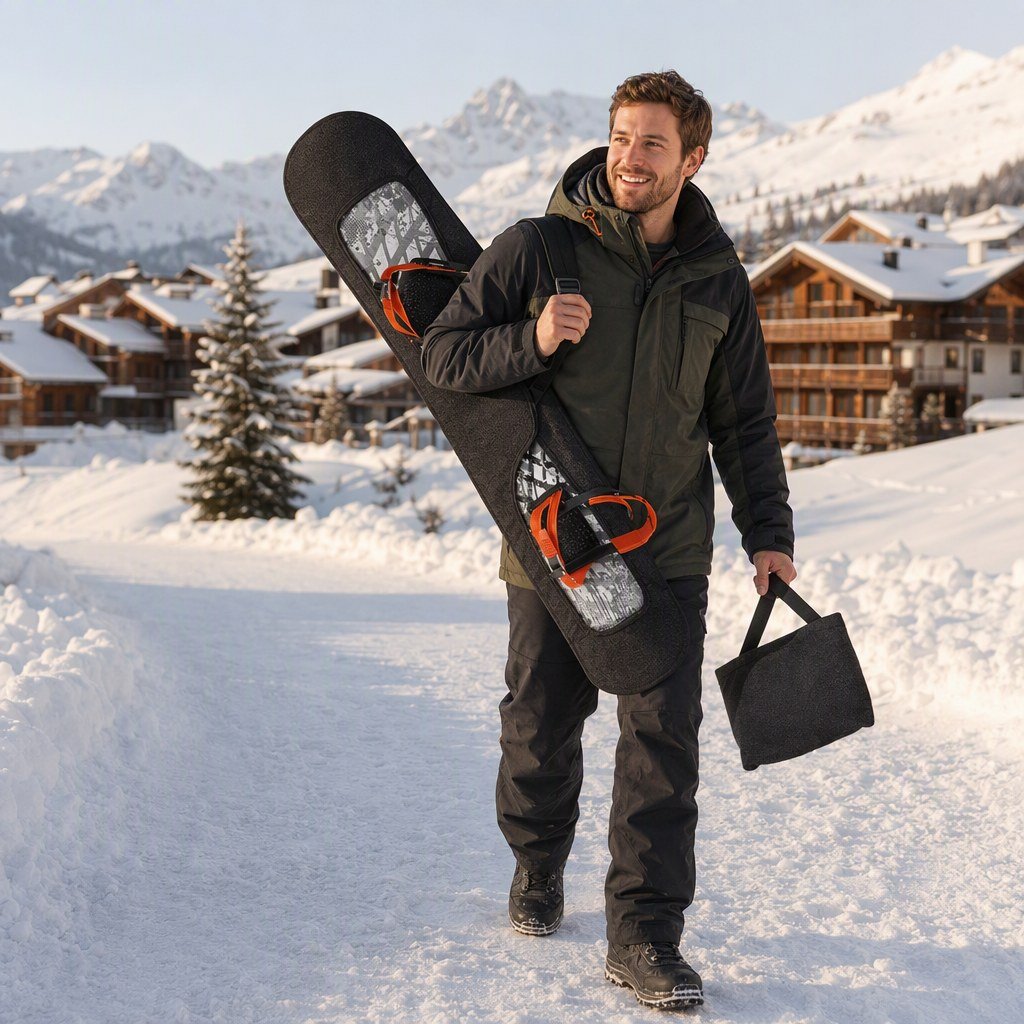
Ski and snowboard accessories are a travel-and-handling category. The two images in this article show the actual use case: a skier loading a padded travel bag into a car at the start of a trip, and a rider carrying a board in a protective cover through an Alpine village. Neither moment is glamorous, and both are exactly where cheap hardware fails — a strap that slips under load, a cover whose base wears through after one airport, a pouch that will not stay closed on a shuttle bus.
For buyers, the practical questions in the first six weeks of the season are consistent: which strap constructions survive cold-weather flex, which cover linings protect edges without adding freight weight, and which carry systems match the rental and school fleets that turn over every season. Our snowsports category covers the range we build most often for European and North American programmes, including adjustable ski straps with hook-and-loop fasteners and neoprene covers, bags and pouches for skis and snowboards.
What we can do for your programme
Vertasport is a factory-direct OEM/ODM manufacturer of sports and outdoor straps and accessories, working across six categories: ski and snowboard, running, trail running, hiking, cycling and pickleball. We produce in hook-and-loop, webbing and neoprene, support low MOQ development for new programmes, and quote within 24 hours. Materials can be specified to REACH and RoHS requirements, with test reports available on request; where a buyer’s compliance programme requires social or quality audits, we can arrange BSCI audit or ISO 9001 recertification on request.
If the Sölden weekend is your season’s starting gun too, send your specification — construction, size, material, packaging — and we will come back with a quotation and a sample plan. Email hxwdavidli@gmail.com or message us on WhatsApp.
Sources: InTheSnow, “Ski World Cup 2026/27 Starts This Weekend in Sölden, Then Heads to Gurgl”, 22 October 2026; SAM (Ski Area Management) Supplier News, October 2026, published 23 October 2026.
Resort Capex Roundup: What October’s Supplier Moves Say About Winter Operations
Boulder, Colorado — 23 October 2026. SAM’s Supplier News roundup for October 2026, published today, reads less like a product bulletin than a capex ledger for the coming winter. In a single page it records an acquisition in snowmaking, a consolidation of service brands in North America, a grooming partnership tied to a multi-sport games, a new access-control product for day lockers, and a workforce partnership with events at two New England mountains this week. For the companies that supply resorts — and for the factories that supply those suppliers — the pattern matters more than any single line item.
Consolidation at the top of the snowmaking chain
The largest move is HTI GROUP’s acquisition of SUPERSNOW, a Polish manufacturer of snow guns, lances and snowmaking systems. SAM frames the deal as an expansion of HTI’s presence in Eastern European markets. For operators, consolidation at the snowmaking tier usually means fewer, larger vendors and a longer service horizon per installed system; for component suppliers, it means the specification conversation now happens inside a bigger organisation, with procurement teams that expect documentation with the part.
The rest of the roundup reinforces the same theme of vendors reorganising around the customer rather than the brand. WINTERSTEIGER unified its North American sales and customer support teams across the WINTERSTEIGER, BOOTDOC and HOTRONIC brands, so a single team now covers ski service, software, storage, boot fitting and retail products. NEVEPLAST extended its LIFT surface from lift loading zones into snowmobile handling and storage areas.
Grooming, games and a multi-season calendar
PRINOTH was selected as the official snow grooming supporting partner for the 2027 Canada Games in Québec. Multi-sport games are a different procurement animal: deadlines fixed years ahead, national visibility, equipment supported in front of an audience. A grooming partnership of that kind signals that the machine side of the mountain is planned on a multi-season horizon.
On the guest-facing side, SMARTE CARTE introduced Smarte Locke, which lets guests open day lockers with their RFID lift tickets instead of a PIN. Less friction at the locker bank, shorter queues at guest services, and more of the guest’s day riding on the RFID credential the resort already issues.
Workforce is now a supply-chain problem
LEITNER-POMA OF AMERICA partnered with THE PIPELINE PROJECT to connect high school career and technical education students with ski industry careers, with full-day events at Gunstock, New Hampshire on 21 October and Killington, Vermont on 23 October, plus a Pipeline Passport programme that maps courses, credentials and on-site experience. Read alongside the rest of the roundup, it is a reminder that resorts are not only buying hardware; they are trying to staff the lifts that run it.
LOAM PASS added Revelstoke Mountain Resort and Grouse Bike Park in British Columbia, Blue Mountain Resort in Pennsylvania, Brian Head Shuttle in Utah and Flow State Biking in Washington for 2027, across a network of more than 80 locations.
What this means for accessory programmes
None of these announcements is about straps, covers or carry systems. The connection is operational rather than contractual, and it runs through the same budget lines. When a resort invests in snowmaking capacity, in grooming fleets, in RFID access and in seasonal staffing, it is also committing to a winter in which terrain opens earlier, more lifts run, and more guests move through rental counters, ski schools and locker rooms. The small hardware that makes those flows work — board covers that survive a shuttle, tip protectors that protect rental edges, straps that hold a pair of skis together on a rack — is bought in the same planning cycle, usually last, and usually under time pressure.
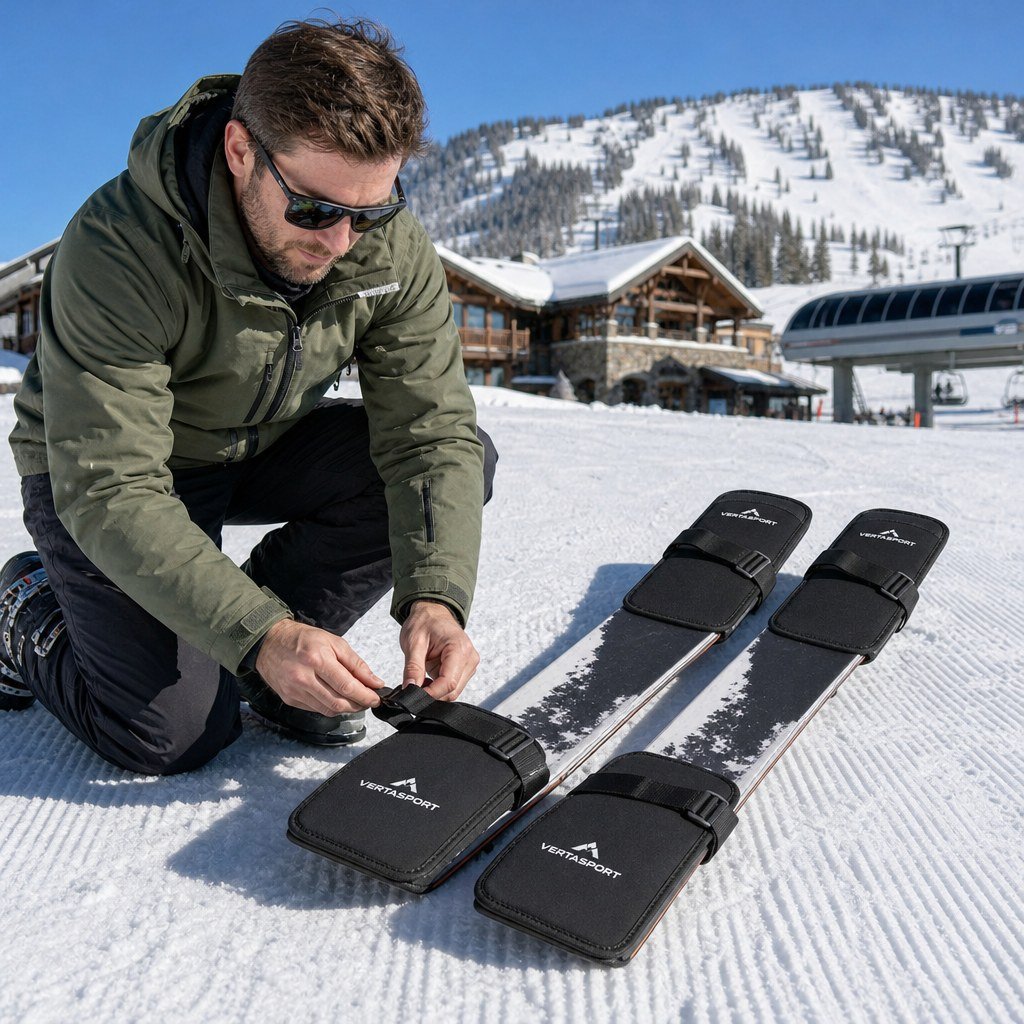
The image above is the moment those purchases are judged: a skier fitting tip and tail protectors on packed snow at the base of a lift, with the resort’s own infrastructure behind him. Nothing in the frame is high technology, yet everything in it has to work at temperature, in gloves, after a season of rental use — which is why the specification conversation for this category is about material thickness, stitching, hook-and-loop grade and edge geometry, not about graphics.
Our snowsports category covers the constructions resort suppliers ask for most often, including adjustable ski straps with hook-and-loop fasteners, neoprene tip and tail protectors, board covers, padded sleeves and foldable travel bags. Because we build to the buyer’s drawings, a resort’s own colourway, logo placement or fleet numbering can sit inside the same programme.
Where a factory-direct partner fits
Vertasport is a factory-direct OEM/ODM manufacturer of sports and outdoor straps and accessories, working across six categories: ski and snowboard, running, trail running, hiking, cycling and pickleball. We produce in hook-and-loop, webbing and neoprene, support low MOQ development for new programmes, and reply to quotations within 24 hours. Materials can be specified to REACH and RoHS requirements with test reports available on request; where a buyer’s compliance programme requires social or quality audits, we can arrange BSCI audit or ISO 9001 recertification on request.
If your winter programme is being locked down while the resorts finish theirs, send the specification — construction, dimensions, material, colourway, packaging — and we will come back with a quotation and a sample plan. Email hxwdavidli@gmail.com or message us on WhatsApp.
Source: SAM (Ski Area Management), “Supplier News — October 2026”, published 23 October 2026.
Sölden Opens the 2026/27 World Cup: The Accessory Buying Window Behind the Race Weekend
Ötztal, Austria — 22 October 2026. The 2026/27 FIS Alpine Ski World Cup begins this weekend on the Rettenbach Glacier above Sölden, with the women’s giant slalom on Saturday 24 October and the men’s giant slalom on Sunday 25 October. InTheSnow published the full Ötztal race programme today, and for anyone selling into the winter sports trade the line worth reading twice is not the start list but the four weeks that follow it: Gurgl hosts the slaloms on 21 and 22 November. Between those two weekends the European winter market moves from a handful of high-altitude operations to something that finally looks like a season.
Racing returns to the Rettenbach Glacier
The opener follows the established pattern: the women race the season’s first giant slalom on the Rettenbach Glacier on Saturday, the men the same blue and red gates the following day. Easy to overlook, reading a race preview in a warm office, is how narrow the early-season map still is. InTheSnow describes Sölden as one of fewer than a dozen areas where the new season is already underway — in a mature Alpine market, October skiing remains a concentrated, high-altitude business.
That concentration is also why the calendar is more fragile than the summer trade ever sees. Snow-forecast.com’s WhiteRoom report on the season start, published earlier this week, confirmed that the race weekend had been cleared after the official snow control. A single warm week can rewrite a race schedule, and a buyer’s shipping plan with it.
Gurgl and the second wave of demand
Four weeks later the circuit converges on the same valley. Gurgl races the women’s slalom on Saturday 21 November and the men’s slalom on Sunday 22 November 2026, on the Kirchenkar piste in Hochgurgl, with the finish set 320 m above the Top Mountain Crosspoint. InTheSnow notes that Gurgl is one of the first resorts to open non-glacier slopes each autumn, precisely because of its altitude.
The commercial meaning is straightforward. Sölden is a race-first occasion: teams, technicians, media and a comparatively specialised crowd. Gurgl arrives as the customer base widens — holiday skiers, weekend trippers, school groups, the people who rent a kit, borrow a board from a friend, or buy their first pair of skis in years.
What a race weekend actually moves
A World Cup weekend is, first, a marketing event. InTheSnow lists bib draws, medal ceremonies and evening parties, and describes spectators in the finish area standing with skis on their shoulders — a detail that captures the real market better than any podium shot. Every one of those people carried something: a strap, a sleeve, a cover, a bag.
Behind the broadcast sits a chain of ordinary operational decisions. Rental fleets are turned over and re-labelled before the Christmas peak. Ski schools restart and re-stock the small items they hand to beginners. Valley retailers re-set wall space around the categories that walk out of the door in December. None of that is decided on race day, but all of it is decided inside the window the race calendar opens.
The procurement window that closes quietly
Straps, covers and carry systems are the parts of a winter programme that nobody photographs and everybody notices when they fail. The questions buyers bring to us in late October are remarkably consistent: which hook-and-loop constructions still hold after repeated cold-weather flexing, which cover linings protect edges without adding freight weight, and which carry systems suit a rental counter that loses straps every week.
Our snowsports category covers the range we build most often for European and North American programmes, from adjustable ski straps with hook-and-loop fasteners through neoprene tip and tail protectors, board covers, padded sleeves and foldable travel bags.
The off-snow half of the order book
Winter is not the only demand curve a factory sees. The buyers who finalise ski straps in October are usually signing off running, hiking and court-sport lines for spring, which is why consolidating one supplier across categories has become a common request rather than an exception. The construction skills transfer: webbing and hook-and-loop assemblies, neoprene laminations, edge binding, and packaging that has to survive a marketplace return.

The photograph above is the other half of that calendar: a player at rest on an outdoor court, flask within reach, in a category that has nothing to do with snow and everything to do with the same accessory supply chain.
What we can do for your programme
Vertasport is a factory-direct OEM/ODM manufacturer of sports and outdoor straps and accessories, working across six categories: ski and snowboard, running, trail running, hiking, cycling and pickleball. We produce in hook-and-loop, webbing and neoprene, support low MOQ development for new programmes, and reply to quotations within 24 hours. Materials can be specified to REACH and RoHS requirements with test reports available on request; where a buyer’s compliance programme requires social or quality audits, we can arrange BSCI audit or ISO 9001 recertification on request.
If the Sölden weekend is your season’s starting gun too, send the specification — construction, dimensions, material, colourway, packaging — and we will come back with a quotation and a sample plan. Email hxwdavidli@gmail.com or message us on WhatsApp.
Sources: InTheSnow, “Ski World Cup 2026/27: Sölden and Gurgl Race Dates”, published 22 October 2026; Snow-forecast.com WhiteRoom, “Green Light For 26-27 Alpine Ski World Cup Start This Weekend”, published before 22 October 2026.
Europe’s Ski Season Starts on the Glaciers: Accessory Order Timing Before the November Trade Window
Europe’s 2026/27 winter is already under way above the tree line. Austria’s glacier resorts opened through the first half of October, the remaining alpine regions follow from early November, and the last trade window of the year closes just before the lifts start turning in earnest. For accessory suppliers and the buyers who plan resort retail programmes, October is where the season is actually decided.
Glaciers First: Austria’s Published 2026/27 Calendar
Austria Tourism published its 2026/27 winter opening overview on 8 September 2026, and the document reads as a countdown rather than a brochure. Carinthia’s Mölltaler Glacier opened on 3 October 2026 and runs to 30 May 2027. The Kitzsteinhorn above Zell am See-Kaprun opened on 10 October 2026, with the season extending into May 2027. Sölden and the Stubai Valley both start their glacier operations in mid-October 2026.
Then the calendar steps down through altitude. Kitzbühel opens on 6 November 2026, Obergurgl-Hochgurgl on 19 November, Obertauern on 20 November, Ischgl on 26 November, and Saalbach-Hinterglemm, Silvretta Montafon and the Tiroler Zugspitz Arena on 27 November. St. Anton am Arlberg and Lech Zürs follow on 2 December 2026, with Serfaus-Fiss-Ladis and Ski Juwel Alpbachtal Wildschönau on 4 December. Austria Tourism is explicit that weather and snow conditions can shift these dates at short notice, which is exactly the uncertainty that accessory buyers have to plan around.
Amsterdam, 3-5 November: the Last Ordering Conversation
The industry’s own calendar mirrors the snow. ISPO, the international trade fair for sporting goods, outdoor and winter sports, moves to RAI Amsterdam for its 2026 edition, running 3-5 November 2026, as confirmed by the organiser. Placed against the Austrian dates above, that timing is not accidental: the fair falls after the glacier openings and before the mass-market November start, which is precisely when remaining assortment gaps get closed and when next-season development briefs are first discussed.
For a factory, this creates two distinct conversations in the same three days. One is the fill-in order for the current season, usually narrow, colour-specific and needed quickly. The other is the development brief for the following winter, where strap geometry, closure type, logo placement and material documentation are set for the first time.
What the Market Data Suggests About Gear Demand
A market release distributed via GlobeNewswire on 2 October 2026 projected that the European ski gear and equipment market will exceed 1.45 billion euros by 2031, pointing to sustainable gear, smart technology and e-commerce as the main growth drivers. The direction of travel is consistent with what buyers have been asking for at the component level: fewer virgin-material claims that cannot be documented, more recycled and recyclable content, and more accessories sold as standalone items through online channels rather than only across a resort shop counter.
That second point changes accessory design. A cover or a pouch bought online has to photograph well, ship flat and explain itself without a salesperson. A strap sold at a rental desk has to survive being handled by staff in gloves. Both have to be documented, because the same e-commerce listing that generates the sale also generates the compliance question.

Why Accessory Purchase Orders Move Before Apparel
In a normal European winter, apparel and hardgoods decisions are locked earliest because they carry the longest development cycles and the largest inventory risk. Accessories sit behind them, but not by much: a resort retail programme needs its covers, straps, leashes and hydration hardware on the shelf for opening weekend, and a distributor needs the range complete before its own catalogue goes to print. The practical consequence is that accessory purchase orders cluster in the weeks around the trade fair, and that late enquiries in December tend to be small, urgent and expensive for everyone involved.
The workable strategy is to keep a short list of core items permanently specified, with colour and logo as the variable, so that a fill-in order becomes a repeat rather than a new development project. Our elite snowsports range is organised this way, and the adjustable ski straps with hook and loop fasteners page shows how a single platform covers several lengths and attachment configurations.
Where the Factory Fits
Vertasport manufactures hook and loop straps, snowsports covers, pouches and TPU soft flasks as a factory-direct OEM/ODM partner for brands, distributors and resort retail programmes. Low MOQ runs support test quantities before a full commitment, and custom logo, label, packaging and Pantone matching are handled in-house rather than through a trading layer. Material documentation is part of the offer: REACH and RoHS declarations are issued alongside the specification, and we can arrange BSCI audit / ISO 9001 recertification on request when a buyer’s own vendor programme requires it.
Before the Lifts Start Turning
If your European winter range still has gaps, or if the 2027/28 development brief is already forming, send the specification, target quantity and destination market. We reply to quotation requests within 24 hours: email hxwdavidli@gmail.com or message us on WhatsApp at wa.me/8613480143331.
Snow Guns Fire Up in Summit County: What Pre-Season Resort Readiness Means for Accessory Stocking
Snowmaking crews in Colorado’s Summit County switched the guns back on overnight on 14 October 2026, and with them the North American pre-season officially started. For resorts this is an operational milestone. For the brands, distributors and resort retail programmes that supply the straps, covers, pouches and hydration hardware skiers actually carry, it is the last clear signal before the winter buying window closes.
Snow Guns On at Keystone and Arapahoe Basin
The Denver Post reported on 15 October 2026 that Keystone Resort and Arapahoe Basin, both in Summit County, began snowmaking operations overnight on Wednesday, 14 October, as storms dusted the mountaintops. Arapahoe Basin president and chief operating officer Alan Henceroth wrote on the resort’s blog that temperatures dropped to 23 degrees, allowing snowmaking on the upper two-thirds of the High Noon run.
The operational detail is worth reading closely, because it explains why resort readiness is never a one-day event. According to the resort release cited by The Denver Post, Keystone operates 1,000 hydrant locations around the mountain, including 39 mobile fan guns, 30 tower fan guns, three arm-mounted fan guns, 500 manual and automatic air/water tower guns and 55 air/water ground guns. Keystone’s senior director of mountain operations, Kate Schifani, called the start of snowmaking one of the most exciting milestones of the year.
Summit Daily reported on 14 October 2026 that Keystone was already selling lift tickets online for Saturday, 24 October, while stressing that no official opening date had been set and that the timeline was simply as soon as possible. Arapahoe Basin, with a base elevation of 10,780 feet, expects roughly a week of good snowmaking before it can open, according to communications manager Shayna Silverman. The paper also noted that crews watch wet-bulb temperature, a combined measure of ambient temperature and humidity, and look for something around 26 degrees Fahrenheit.
Loveland Ski Area was equally precise: the resort began snowmaking at 7:04 p.m. on Wednesday, 14 October and is targeting an opening between late October and early November, weather and conditions permitting, according to its own announcement dated 15 October 2026.
Pre-Season Dates Were Fixed Months Ago
Resort calendars are published long before the first gun fires. Vail Resorts’ announcement of 18 August 2026 listed Keystone as opening as soon as possible in October, Breckenridge on 6 November and Vail Mountain on 13 November. Further west, The Sacramento Bee reported on 12 October 2026 that Mt. Rose Ski Tahoe had started snowmaking and plans to open on 6 November, conditions permitting.
That sequencing matters to suppliers. The purchase order behind a season that opens in early November is placed in late summer and early autumn, not in December. By the time the snow guns run, retailers are not starting their buy, they are filling the gaps in it.
Why Last Winter Changes This One
Summit Daily noted on 14 October 2026 that the previous winter was marked by record-low snowpack across much of the West and the lowest ski visitation in more than 35 years in Colorado. Retailers who carried heavy seasonal inventory through a poor snow year tend to buy later and tighter the next season, and to favour accessories that sell through on their own rather than only as an add-on to a big-ticket purchase such as a board, a boot or a pass. Deep colour ranges and narrow size runs replace broad speculative assortments.

Snow Control, Storage and Carry: the Opening-Week List
Opening week produces a predictable burst of accessory demand at resort shops, rental desks and online stores: board and ski covers for transport and off-season storage, hook and loop straps for bundling poles and boards, leashes, goggle and glove retainers, and hydration hardware for the warm-up weekends when lifts run but the alpine air is dry. Our elite snowsports range was built around that list rather than around the hardware.
Two specification questions come up in almost every pre-season enquiry. The first is cold-weather closure performance: hook and loop systems that still hold on wet nylon, at low temperature, and with a gloved hand doing the pulling. The second is material documentation. REACH and RoHS declarations for the textile, foam and TPU components inside covers, pouches and flasks are now a routine request from European and North American buyers, and they are easier to supply when the factory owns the specification from the start.
Factory-Direct OEM/ODM for a Short Buying Window
Vertasport is an OEM/ODM manufacturer of hook and loop straps, snowsports covers, pouches and TPU soft flasks, supplying brands, distributors and resort retail programmes directly from the factory. Low MOQ runs allow a buyer to test a colourway or a single size on a narrow assortment before committing, and custom logo, label, packaging and Pantone matching are handled in-house. We can arrange BSCI audit / ISO 9001 recertification on request, and we issue REACH and RoHS documentation alongside the material specification. Where a programme needs a specific strap geometry, we tool and sample against the drawing rather than offering the closest catalogue item; the adjustable ski straps with hook and loop fasteners page shows the current build options.
Next Step for Pre-Season Stocking
If your 2026/27 assortment still has open slots, send the specification, target quantity and destination market. Our team replies to quotation requests within 24 hours: email hxwdavidli@gmail.com or message us on WhatsApp at wa.me/8613480143331.
Sölden Clears FIS Snow Control as the 2026/27 World Cup Opens October 24: The Final Q4 Sourcing Window for Ski Straps and Snow Gear
Sölden, Austria — 19 October 2026. The 2026/27 alpine season has a confirmed starting gun. On Thursday 15 October, FIS officials completed the snow control on the Rettenbach Glacier and cleared the Audi FIS Ski World Cup opener for 24–25 October, as reported by SnowBrains and confirmed by the Sölden event programme. For brands and private-label buyers, that green light matters beyond race day: European retail has stopped asking whether the season starts on time and started asking what must be on shelf before the first powder weekend.
Sölden clears snow control: two giant slaloms confirmed
The opening weekend keeps its traditional shape. The women’s giant slalom runs on Saturday 24 October, the men’s race follows on Sunday 25 October, and both are two-run formats with the first run at 10:00 local time and the second at 13:00. The Rettenbach course is one of the more demanding early-season tests on the calendar, with gradients reaching 68 percent and a vertical drop of roughly 370 metres.
The start list brings the usual headlines: Marco Odermatt and Lucas Pinheiro Braathen on the men’s side, Austria’s Julia Scheib defending her Sölden win, and Mikaela Shiffrin expected to start, subject to the final list. Italy is without Sofia Goggia and Federica Brignone, both still recovering, while Marta Bassino returns after a season out.
Commercially, the timing matters more than the names. A passed snow control two weeks out tells the trade that the glacier circuit is functioning and that the first consumer-facing ski content of the winter lands on 24 October. Retail marketing calendars, rental fleets and demo programmes all key off that date.
Austria now leads the open-resort count
The wider picture is improving after a record-warm Alpine summer. J2Ski’s 15 October snow report counted eight Alpine areas open and noted that Austria has overtaken Chile and New Zealand for the most areas running, with five glaciers operating: Pitztal, Hintertux, Sölden, Stubai and Kitzsteinhorn. Sölden offers the most terrain at around 18 km, and the report recorded up to 20 cm of new snow above 1,600 m and 30 cm above 3,000 m — the lowest snowline of the autumn so far.
Not every opening has gone to plan. SnowStash’s mid-October guide notes that Titlis pushed its glacier opening back two weeks to 24 October, that Zermatt restarted only a handful of high-altitude lifts on 14 October after more than two months closed, the full resort due on 1 November, and that Finland’s Levi and Ruka are running on stored snow-farmed reserves with roughly 2.5 km each. The same guide cites GLAMOS data showing a 5.5 percent loss of Swiss glacier ice volume in 2025-26, the second-largest on record.
Thin early-season bases have a direct product consequence. When snow is marginal, resorts and rental operators lean harder on protection: tip and tail covers, padded sleeves and carrier straps that keep demo skis intact between transfers. Durability moves up the buying criteria list, and consumables that fail in week one become a warranty conversation.
A compressed trade calendar leaves little slack
The commercial calendar is tighter than usual. ISPO 2026 moves to Amsterdam from 3–5 November with more than 850 exhibitors confirmed, over 25,000 trade visitors expected and retailers including INTERSPORT, Ellis Brigham, JD Outdoor, Mountain Warehouse and Amazon engaged. In Munich, The Outdoor Industry Compass called this month’s Performance Days a record-breaking edition, with natural materials still gaining share in performance textiles.
The arithmetic is simple: the World Cup opener is 24 October, ISPO opens 10 days later, and most European buy plans for the winter 2027 assortment are shaped in that window. An accessory programme without a confirmed production slot before the shows tends to land on a later, more expensive schedule.
What buyers are reordering for the glacier season
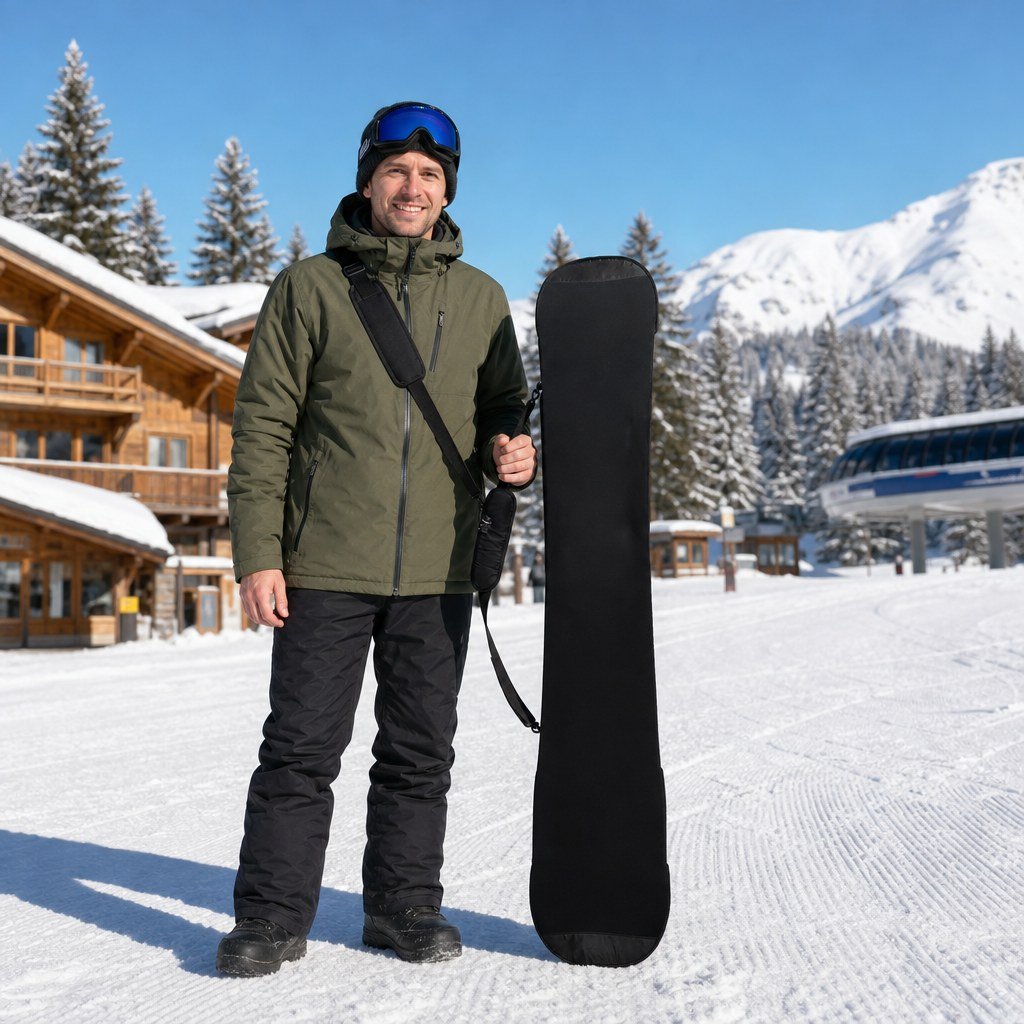
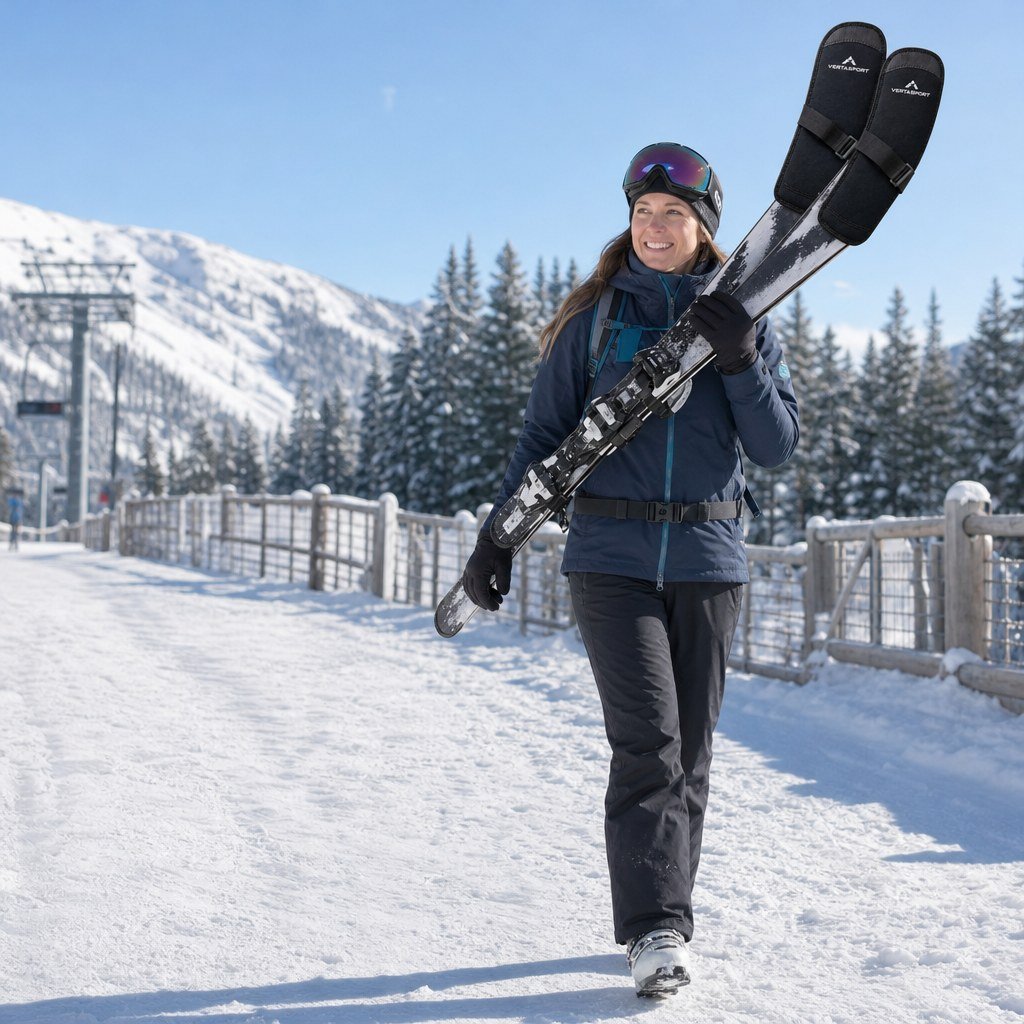
The strongest reorder demand sits in the components that travel with the skis rather than on them. Adjustable hook-and-loop ski carrier straps remain the volume driver: two skis, one hand, no rattle on the gondola. Neoprene tip and tail protectors and padded snowboard sleeves with shoulder straps follow, driven by rental fleets and by travellers who check a bag once a year and expect it to survive.
Browse the full elite snowsports range and the equipment straps category for the current SKUs. The same hook-and-loop platform carries over into trail running and pickleball accessories, which lets distributors consolidate a single supplier across categories instead of managing four.
Factory-direct supply before the first race weekend
We manufacture these accessories in our own Shenzhen facility with 16+ years of hook-and-loop and neoprene production, supplying OEM and ODM programmes for snowsports, running, hiking and cycling brands. For a Q4 or early-2027 programme: low MOQ on first orders and colour tests, custom sizing and webbing width, logo embossing, retail-ready packaging, REACH and RoHS compliant materials with test reports, and a quote within 24 hours of a clear spec.
Where buyers need documentation for their own compliance files, we can arrange BSCI audit / ISO 9001 recertification on request — stated plainly rather than claimed as a certificate. Sampling usually starts from a spec sheet plus a target landed cost; send both and we return a costed option.
Next step
The season starts on the Rettenbach Glacier on 24 October, and the comfortable production window before ISPO Amsterdam closes soon after. If your winter 2027 range still needs ski carrier straps, neoprene covers or padded travel bags, send the spec to hxwdavidli@gmail.com or message us on WhatsApp for a factory-direct quote within 24 hours.